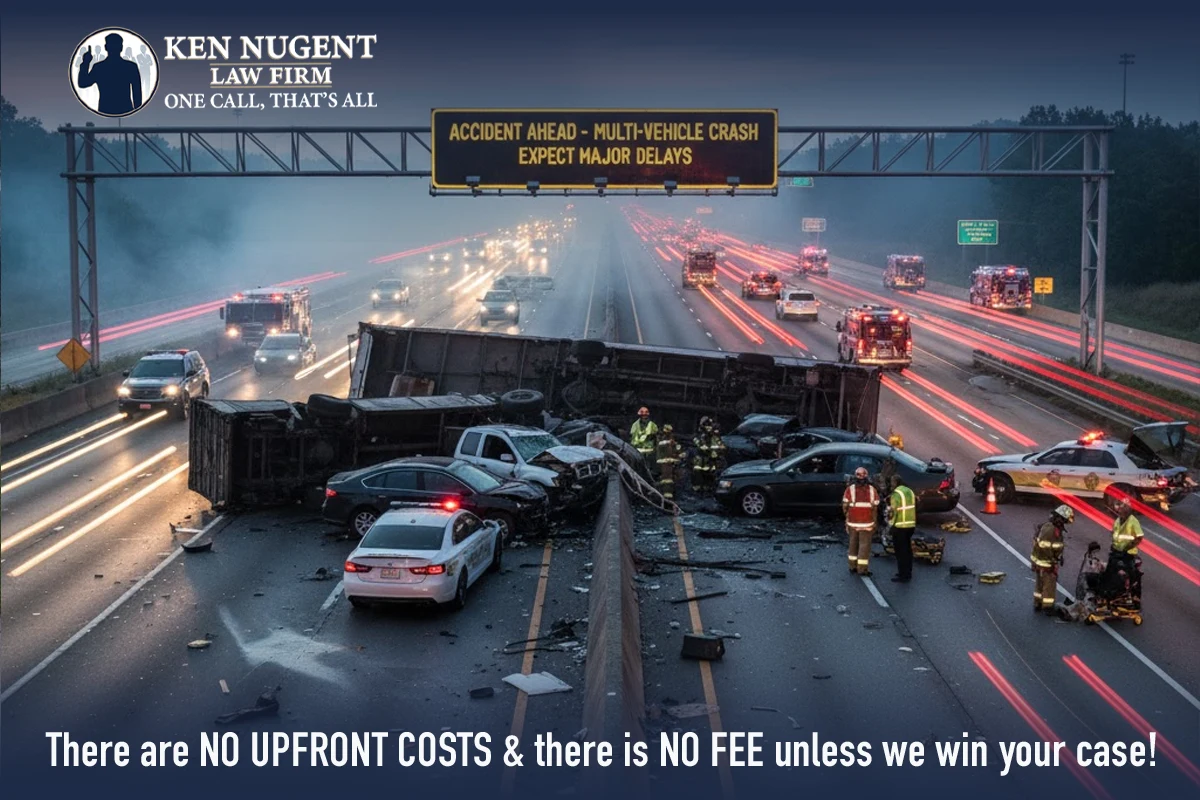
Multi-vehicle collisions represent some of the most complex accident cases in Columbus, Georgia. With many car and truck collisions occurring in Columbus every year—understanding how fault is determined has never been more critical for accident victims seeking compensation.
When three or more vehicles collide, establishing liability becomes significantly more challenging than in traditional two-car accidents. Multiple drivers may share responsibility, insurance companies conduct competing investigations, and the sequence of events can be disputed from several perspectives. For Columbus residents navigating the aftermath of a multi-vehicle crash, knowing how Georgia law determines fault can make the difference between a fair settlement and a denied claim.
At Kenneth S. Nugent, P.C., our Columbus legal team has extensive experience unraveling the complexities of multi-vehicle collision cases, ensuring that fault is accurately assigned and our clients receive full compensation for their injuries and losses.
Understanding Georgia’s Modified Comparative Negligence Rule
Georgia follows a modified comparative negligence system that directly impacts how fault is determined and how compensation is calculated in multi-vehicle collisions. This legal framework allows multiple parties to share responsibility for an accident, but with important limitations.
The 50% Threshold: A Critical Barrier
Under Georgia law (O.C.G.A. § 51-12-33), you can recover damages after a multi-vehicle collision only if your percentage of fault is less than 50%. This creates a crucial threshold:
- Less than 50% at fault: You can recover compensation, but your award will be reduced by your percentage of fault
- 50% or more at fault: You are completely barred from recovering any compensation
How Comparative Fault Affects Your Recovery
In a multi-vehicle collision scenario, fault percentages are assigned to each driver involved. Here’s how it works in practice:
Example:
Three vehicles collide at a Columbus intersection. Driver A suddenly stops without signaling (60% at fault), Driver B was following too closely (30% at fault), and Driver C was distracted by their phone (10% at fault). If Driver C sustained $50,000 in damages, they could recover $45,000 (90% of their damages) because they were only 10% responsible.
However, Driver A, being more than 50% at fault, cannot recover anything from the other drivers, regardless of injuries sustained.
Why Fault Percentages Matter in Columbus Multi-Vehicle Cases
Insurance companies understand Georgia’s comparative negligence rule intimately, and they use it to their advantage. Adjusters will actively work to assign you a higher percentage of fault—ideally reaching that 50% threshold that bars your recovery entirely. This is why accurate fault determination through proper investigation and legal representation is essential in Columbus multi-vehicle collision cases.
The Multi-Vehicle Collision Fault Determination Process
Determining fault in a multi-vehicle collision involves a systematic investigation that combines evidence collection, legal analysis, and often expert reconstruction. Understanding this process helps Columbus accident victims protect their rights from the outset.
Initial Police Investigation
When Columbus Police Department officers respond to a multi-vehicle collision scene, they conduct the first official investigation. This includes:
- Driver and passenger interviews: Officers collect statements from everyone involved, documenting each person’s account of the collision sequence
- Witness identification: Independent bystanders often provide the most objective perspectives on what actually occurred
- Physical evidence documentation: Officers photograph vehicle positions, skid marks, debris fields, road conditions, and traffic control devices
- Traffic violation assessment: Citations issued at the scene can indicate which drivers violated traffic laws, though violations don’t automatically establish complete fault
- Preliminary fault assessment: While not legally binding, the officer’s professional judgment about fault carries significant weight with insurance companies
The Columbus Police Department’s accident report becomes a foundational document in your case. You can obtain your report through www.buycrash.com or by visiting the Public Safety Building in person.
Insurance Company Investigations
Each driver’s insurance company conducts its own investigation, often with very different objectives than discovering the truth. Insurance adjusters will:
- Review the police report and any available evidence
- Conduct their own driver interviews (often recorded without your knowledge of how statements may be used against you)
- Examine vehicle damage patterns to determine impact sequences
- Apply their company’s internal liability assessment guidelines
- Seek any basis to assign you higher fault percentages to reduce their payout
Critical Warning: Insurance adjusters are not working in your best interest, even your own insurance company. Statements you make can be taken out of context or used to establish partial fault that reduces your compensation.
Legal Investigation and Evidence Gathering
When you work with an experienced Columbus multi-vehicle collision attorney, a comprehensive legal investigation goes far beyond what police and insurance companies uncover:
- Independent accident reconstruction: Specialists use physics, engineering principles, and collision analysis to determine exactly how the crash occurred
- Advanced evidence collection: This includes surveillance footage from nearby businesses, traffic camera recordings, event data recorder (EDR/”black box”) downloads from vehicles, and cellular phone records that may show distracted driving
- Expert witness consultation: Mechanical engineers, accident reconstructionists, and medical professionals provide authoritative analysis
- Comprehensive witness interviews: Unlike brief police interviews, attorneys conduct detailed depositions that thoroughly explore witness observations
- Chain of causation analysis: Determining not just who was negligent, but whose negligence directly caused which damages
Critical Evidence in Multi-Vehicle Collision Cases
Fault determination hinges on the quality and quantity of evidence available. Understanding what evidence carries the most weight helps Columbus accident victims protect their claims from the moment a collision occurs.
Physical Evidence from the Scene
Vehicle damage patterns: The location, severity, and type of damage on each vehicle tells a scientific story about impact forces, collision sequence, and driver positions. Modern accident reconstructionists can determine vehicle speeds, angles of impact, and the order of collisions based solely on damage analysis.
Roadway evidence: Skid marks, tire tracks, gouges in pavement, debris scatter patterns, and final vehicle positions all provide objective data about pre-collision driver actions and the collision dynamics.
Environmental factors: Road conditions, weather, visibility, lighting, traffic control device functionality, and sight-line obstructions can all contribute to fault analysis.
Witness Testimony
Independent witnesses: Bystanders with no stake in the outcome often provide the most credible accounts. Their perspectives can confirm or contradict driver statements, particularly regarding traffic signal status, right-of-way, and driver behavior immediately before the collision.
Driver statements: While each driver’s account is important, these statements are often self-serving and may contradict physical evidence. Admissions made at the scene (such as apologizing or saying “I didn’t see you”) carry significant legal weight.
Passenger accounts: Passengers can provide valuable information about driver behavior, distractions, or impairment before the collision.
Documentary and Digital Evidence
Video footage: Dashboard cameras, security cameras from nearby businesses, traffic cameras, and even bystander cell phone videos provide indisputable real-time documentation of exactly how a collision occurred.
Event data recorders (EDR): Modern vehicles contain “black boxes” that record crucial data including speed, brake application, throttle position, steering input, and seatbelt usage in the seconds before and during a collision.
Cell phone records: Timestamps of calls, texts, or app usage can prove distracted driving, even without direct eyewitness observation.
Medical records: While primarily used to document injuries, medical records that show the absence of impairment or medical emergencies that might explain sudden driving changes can support fault arguments.
Expert Analysis
Accident reconstruction reports: These detailed technical analyses use physics, engineering, and all available evidence to scientifically determine how a collision occurred, often providing definitive answers to disputed fault questions.
Vehicle mechanical inspections: Expert examination can determine whether mechanical failure (such as brake failure) contributed to a collision, potentially shifting fault away from the driver.
Toxicology reports: When impairment is suspected, blood or urine analysis definitively establishes whether drugs or alcohol played a role.
Columbus’s Most Dangerous Intersections for Multi-Vehicle Collisions
Certain Columbus locations consistently experience higher rates of multi-vehicle collisions due to complex traffic patterns, high volume, and challenging intersection designs. Understanding these high-risk areas can help Columbus drivers exercise extra caution—and if you’ve been involved in a collision at one of these locations, it demonstrates the dangerous conditions that may have contributed to your accident.
Interstate 185 and Macon Road (Exit 6)
This intersection consistently ranks among Columbus’s most dangerous, with multiple serious multi-vehicle collisions documented throughout 2024. The exit ramp design, combined with heavy commercial truck traffic transitioning between I-185 and Macon Road, creates numerous conflict points where vehicles merge, cross paths, and make turning movements simultaneously.
Common collision patterns: Rear-end crashes as vehicles slow for the exit, side-impact collisions when drivers misjudge gaps in traffic while merging onto Macon Road, and multi-vehicle chain reactions during peak traffic hours.
Contributing factors: High-speed differential between interstate traffic and slower-moving vehicles on the ramp, limited sight distances for drivers entering from the ramp, and confusion about right-of-way when multiple vehicles attempt to merge simultaneously.
Interstate 185 and Manchester Expressway (Exit 7)
The Manchester Expressway interchange sees frequent multi-vehicle collisions, particularly involving vehicles transitioning between I-185 and the expressway. Multiple traffic reports throughout 2024 document serious crashes that closed lanes and caused extended delays.
Common collision patterns: Lane-change collisions as drivers merge onto the expressway, rear-end chain reactions during congestion, and side-swipe accidents when multiple vehicles attempt lane changes simultaneously.
Contributing factors: Heavy commuter traffic during rush hours, commercial truck congestion, short merging lanes that force quick decision-making, and drivers traveling at excessive speeds on both the interstate and expressway.
I-185 Between Macon Road and Manchester Expressway
This stretch of interstate itself, not just the exits, experiences numerous multi-vehicle collisions. The corridor between these two major exits sees heavy traffic flow, frequent lane changes, and vehicles traveling at varying speeds, creating dangerous conditions.
Common collision patterns: Multi-vehicle rear-end collisions during slowdowns, vehicles striking stopped traffic from previous accidents, and side-impact crashes when drivers change lanes without adequate checking.
Contributing factors: Traffic congestion that creates sudden slowdowns, limited escape routes when drivers recognize danger ahead, and the “accordion effect” where braking ripples backward through traffic.
Manchester Expressway and 17th Street
This busy intersection experiences significant pedestrian, bicycle, and vehicle traffic, making it a hotspot for complex multi-party collisions. The mix of commuter traffic, local business access, and vulnerable road users creates numerous potential conflict points.
Common collision patterns: Intersection collisions involving vehicles turning left across traffic, rear-end collisions as drivers brake for pedestrians or slowing traffic, and multi-vehicle crashes when drivers run red lights or misjudge signal changes.
Contributing factors: High pedestrian traffic forcing vehicles to stop suddenly, drivers distracted by roadside businesses, multiple traffic signal phases creating confusion about right-of-way, and aggressive drivers attempting to “beat” signal changes.
Macon Road at I-185
Beyond the interstate interchange itself, Macon Road sees significant multi-vehicle collision activity where local traffic interacts with vehicles entering and exiting I-185. This area experiences the dangerous combination of high-speed interstate traffic mixing with slower-moving local vehicles.
Common collision patterns: T-bone collisions at intersections near the interstate, rear-end crashes as drivers slow for turns or to enter businesses, and multi-vehicle collisions during peak traffic when congestion is highest.
Contributing factors: Vehicles entering Macon Road from the interstate at high speeds, frequent stopping and turning for business access, inadequate acceleration and deceleration lanes, and driver inattention in familiar commute areas.
Schatulga Road and Flat Rock Road
This intersection gained tragic notoriety in June 2024 when a multi-vehicle collision claimed the lives of two Columbus residents. The area continues to see concerning collision rates, particularly involving vehicles traveling at higher speeds on Schatulga Road.
Common collision patterns: High-speed angle collisions, multi-vehicle crashes when one collision triggers secondary impacts, and visibility-related accidents during adverse weather.
Contributing factors: Higher speed limits on Schatulga Road, limited sight distances approaching the intersection, and the mix of through traffic and turning vehicles creating conflict points.
Woodruff Farm Road Corridor
Multiple multi-vehicle wrecks have been documented along Woodruff Farm Road, with Columbus Police and Fire Department responding regularly to serious collisions. The road’s design and traffic patterns create ongoing safety concerns.
Common collision patterns: Head-on collisions when vehicles cross the center line, side-swipe accidents during passing maneuvers, and multi-vehicle rear-end crashes during traffic slowdowns.
Contributing factors: Curving road sections with limited visibility, vehicles traveling at speeds inappropriate for conditions, and inadequate shoulders that leave no escape routes when drivers recognize danger.
Buena Vista Road Exit Area (I-185 Exit 4)
The Buena Vista Road exit consistently experiences traffic accidents, with reports throughout 2024 of crashes causing lane closures and traffic diversions. The area’s design creates challenging conditions for drivers entering and exiting the interstate.
Common collision patterns: Merging collisions as vehicles enter I-185, rear-end crashes at the end of exit ramps, and multi-vehicle chain reactions during congested periods.
Contributing factors: Short merging lanes requiring quick acceleration, traffic backing up from the intersection at the end of the ramp, and confusion about right-of-way when multiple vehicles attempt to merge simultaneously.
Why Intersection Location Matters in Your Case
If your multi-vehicle collision occurred at one of these known dangerous intersections, this fact strengthens your case by demonstrating:
- The city’s or state’s potential awareness of dangerous conditions
- A pattern of similar collisions suggesting environmental or design factors contributed to your crash
- That reasonable drivers face challenges at this location, supporting arguments against comparative fault
- Possible third-party liability claims against governmental entities for dangerous road conditions
Our Columbus legal team maintains detailed records of collision patterns at these and other dangerous intersections, which we use to support our clients’ claims and demonstrate that external factors beyond driver control contributed to multi-vehicle collisions.
Common Multi-Vehicle Collision Scenarios in Columbus
Chain-Reaction Rear-End Collisions
These occur frequently on I-185 and Manchester Expressway when one vehicle fails to brake in time, striking the vehicle ahead, which then impacts the next vehicle forward. Fault typically begins with the rearmost driver but can be distributed based on contributing factors like sudden stops or disabled vehicles.
Intersection Collisions
When multiple vehicles collide at Columbus intersections—particularly at Macon Road and Manchester Expressway intersections—fault often hinges on right-of-way determinations, traffic signal status, and witness testimony about who entered the intersection first or violated traffic control devices.
Lane Change and Merging Collisions
Multiple vehicles attempting simultaneous lane changes or merging onto Columbus highways create side-swipe and angle collision scenarios where fault may be shared based on each driver’s duty to ensure safe lane changes and yield appropriately.
Weather-Related Pile-Ups
When rain, fog, or other adverse weather reduces visibility on Columbus roadways, multi-vehicle collisions can occur rapidly as drivers fail to adjust speed for conditions. Fault analysis considers whether each driver operated reasonably for the weather conditions.
What to Do After a Columbus Multi-Vehicle Collision
The actions you take in the hours and days following a multi-vehicle collision directly impact fault determination and your ability to recover compensation. Follow these critical steps to protect your legal rights:
At the Accident Scene
- Ensure safety first: Move to a safe location if possible, check for injuries, and call 911 immediately to report the collision and request medical assistance if needed
- Wait for Columbus Police: Never leave the scene before police arrive and complete their investigation, even if the collision seems minor
- Document everything: Take photographs of all vehicle damage, the accident scene from multiple angles, traffic control devices, road conditions, weather, and any visible injuries
- Identify all parties: Exchange information with every driver involved—names, contact information, insurance details, and license plate numbers
- Locate witnesses: Get contact information from anyone who saw the collision, as their independent observations can be crucial to fault determination
- Limit your statements: Provide factual information to police, but avoid speculating about fault, apologizing, or making detailed statements to other drivers or their insurance companies
- Do not admit fault: Even if you believe you may have contributed to the collision, fault determination is a complex legal analysis best left to professionals
Immediately After the Collision
- Seek medical evaluation: Visit an emergency room or your physician even if you feel fine—some serious injuries have delayed symptoms, and immediate medical evaluation creates important documentation
- Obtain the police report: Get the accident report number from the responding officer and obtain a copy as soon as it becomes available
- Notify your insurance: Report the collision to your insurance company, but provide only basic factual information—avoid detailed recorded statements until after consulting an attorney
- Preserve evidence: Keep all physical evidence from the collision, including damaged personal property, clothing worn during the crash, and photographs taken at the scene
- Document your injuries and losses: Keep detailed records of medical treatments, missed work, expenses incurred, and how injuries impact your daily life
Critical Warning: What NOT to Do
- Do not give recorded statements to any insurance company without legal representation
- Do not accept early settlement offers before you understand the full extent of your injuries and losses
- Do not post about the collision on social media—insurance companies monitor social media and use posts to argue you were not seriously injured
- Do not sign any documents from insurance companies without attorney review
- Do not delay seeking legal counsel—evidence disappears, witnesses’ memories fade, and Georgia’s statute of limitations creates strict deadlines
Why Multi-Vehicle Collision Cases Require Experienced Legal Representation
Multi-vehicle collisions involve unique complexities that make attorney representation essential rather than optional. Here’s why Columbus multi-vehicle collision victims need specialized legal counsel:
Multiple Insurance Companies = Multiplied Challenges
Unlike two-car accidents with two insurance companies, multi-vehicle collisions can involve three, four, or more insurance companies—each with adjusters working to minimize their payout by maximizing your fault. Coordinating claims, protecting your interests against multiple adverse parties, and ensuring you recover from all responsible parties requires strategic legal expertise.
Complex Fault Allocation
When fault is distributed among multiple drivers, determining each party’s precise percentage requires sophisticated legal and technical analysis. Insurance companies will argue for fault allocations that minimize their obligations—you need an attorney who can counter these arguments with evidence-based analysis and advocate for accurate fault determination.
Georgia’s 50% Bar Rule Creates High Stakes
Because exceeding 49% fault means total loss of compensation, even slight errors in fault allocation can cost you everything. Insurance companies know this and will aggressively push to assign you just enough fault to cross that threshold. Experienced legal representation is your defense against these tactics.
Maximizing Your Total Recovery
In multi-vehicle collisions, you may have claims against multiple at-fault parties. An experienced attorney identifies all responsible parties, pursues all available insurance coverage, and ensures you recover maximum compensation from every applicable source—something that’s nearly impossible to achieve without legal representation.
Evidence Preservation and Expert Resources
Multi-vehicle collision cases often require accident reconstruction experts, mechanical engineers, medical specialists, and other professionals to definitively establish fault. Our firm has established relationships with top experts and the resources to fund thorough investigations that individual accident victims cannot typically afford upfront.
Georgia’s Statute of Limitations
Georgia law imposes strict deadlines for filing personal injury lawsuits after motor vehicle accidents. Missing these deadlines means losing your right to compensation forever, regardless of how strong your case might be. An attorney ensures all legal deadlines are met while you focus on medical recovery.
Trial Experience When Necessary
While most multi-vehicle collision cases settle, complex fault disputes and multiple parties sometimes necessitate trial. Having an attorney with proven courtroom experience gives you leverage in negotiations and ensures you’re prepared if your case goes before a jury.
How Kenneth S. Nugent, P.C. Handles Columbus Multi-Vehicle Collision Cases
Our Columbus legal team follows a systematic approach to multi-vehicle collision cases that has successfully helped hundreds of Georgia accident victims recover full compensation:
Comprehensive Case Investigation
We conduct independent investigations that go far beyond police reports and insurance company assessments. This includes visiting the accident scene, locating and interviewing witnesses, obtaining surveillance footage, downloading vehicle event data recorders, and consulting with accident reconstruction experts when needed.
Strategic Fault Analysis
We systematically analyze all available evidence to determine accurate fault percentages, identify weaknesses in insurance company fault arguments, and build compelling evidence-based presentations that demonstrate other parties’ negligence while minimizing arguments against you.
Aggressive Negotiation With Multiple Insurance Companies
We manage all communications with every insurance company involved, protecting you from recorded statements, ensuring all applicable insurance coverage is identified, negotiating simultaneously with multiple insurers, and leveraging our knowledge of comparative negligence law to counter low-ball offers.
Maximum Compensation Recovery
We ensure our clients receive full compensation for all damages, including immediate and future medical expenses, lost wages and diminished earning capacity, property damage and diminished vehicle value (including Georgia’s unique diminished value claims), pain and suffering, emotional trauma and psychological impacts, and disability and life care costs for catastrophic injuries.
Proven Track Record
Our Columbus office has recovered millions of dollars for Georgia accident victims through strategic case preparation, aggressive advocacy, and trial experience when settlement negotiations fail. We handle all personal injury cases on a contingency fee basis—you pay no attorney fees unless we recover compensation for you.
Time Is Critical in Multi-Vehicle Collision Cases
Evidence disappears quickly after motor vehicle accidents. Security camera footage is recorded over, witnesses’ memories fade, vehicles are repaired or totaled destroying physical evidence, and accident scenes change with road repairs or weather. Additionally, Georgia’s statute of limitations creates strict legal deadlines that, if missed, forever bar your right to compensation.
The sooner you contact our Columbus legal team, the more effectively we can preserve critical evidence, conduct timely investigations, and protect your legal rights against insurance companies already working to minimize your claim.
Contact Our Columbus Multi-Vehicle Collision Lawyers Today
If you’ve been injured in a multi-vehicle collision in Columbus, Georgia, understanding how fault is determined is only the beginning. Protecting your rights, countering insurance company tactics, and recovering full compensation requires experienced legal representation that knows how to navigate Georgia’s comparative negligence laws and multi-party accident complexities.
Kenneth S. Nugent, P.C. has served Columbus accident victims for years, building a reputation for thorough investigation, aggressive advocacy, and successful results in even the most complex multi-vehicle collision cases. Our Columbus legal team is ready to provide you with a free, no-obligation case evaluation to discuss how fault will be determined in your case and what compensation you may be entitled to recover.
Contact us today for your free consultation:
- Call: (706) 807-8232
- Visit: Our Columbus office at 1234 1st Ave STE 200, Columbus, GA 31901
- Online: Complete our confidential contact form
Don’t navigate the complexities of a multi-vehicle collision claim alone. Let our experienced Columbus legal team fight for the compensation you deserve while you focus on recovery. Remember—we work on a contingency fee basis, which means you pay no attorney fees unless we recover compensation for you.
The statute of limitations for personal injury claims in Georgia creates strict deadlines. Contact us today to protect your rights.
Disclaimer: This blog post is for informational purposes only and does not constitute legal advice. Every motor vehicle accident case is unique, and outcomes depend on specific facts and circumstances. Past results do not guarantee future outcomes. For advice about your specific situation, please contact our office for a confidential consultation with one of our attorneys. Kenneth S. Nugent, P.C. represents accident victims throughout Georgia including Columbus, Albany, Athens, Atlanta, Augusta, Duluth, Macon, Savannah, and Valdosta.
About the Firm: Kenneth S. Nugent, P.C. is a Georgia personal injury law firm with offices across the state, dedicated to helping accident victims recover full compensation for injuries caused by others’ negligence. Our Columbus office serves Muscogee County and surrounding areas with experienced legal representation in motor vehicle accident cases.
 Injured? Call Us Now!